Showing posts with label geometry. Show all posts
Showing posts with label geometry. Show all posts
Algorithms and Art

The Islands of Benoît Mandelbrot


The Bard Graduate Center recently closed a show entitled "The Islands ofBenoît Mandelbrot:Fractals, Chaos, and theMateriality of Thinking". Interesting, for a computer scientist to have a show in what has historically been an institution dedicated to showcasing the arts.
Benoit Mandelbrot is perhaps most famous for his work involving fractals (including helping to generate the mountains in Star Trek II). Fractals are shapes that exhibit the interesting property of having self-similarity. This fractal was named after Mandelbrot:

This "art" show at the Bard Graduate Center focused on the visual record of the mathematical discovery of the mysterious properties of these shapes:

It's hard to find visual artifacts to document the lifespan of a mathematical discovery. Several pieces in the show are obviously sketches of ideas that have yet to come to full fruition.
- New York Times coverage of the Islands of Benoit Mandelbrot
- Exhibition Catalog- The Islands of Benoit Mandelbrot: Fractals, Chaos, and the Materiality of Thinking
- The Computational Beauty of Nature: Computer Explorations of Fractals, Chaos, Complex Systems, and Adaptation
- Making the Genesis Effect in Star Trek II

Basic Perspective Drawing: A Visual Guide

Basic Perspective Drawing: A Visual Guide
 by John Montague is a beautifully illustrated "text" book that guides readers into a detailed and in-depth understanding of perspective drawing.
 What is perspective drawing? Consider this Durer print:

Here, Durer is illustrating how an artist might use some of the rules of perspective to draw a lute. The drawing of the lute is a flat, 2-dimensional surface. By using tricks of single point perspective, the artist is able to create the illusion of 3-dimensionality. Using mathematical techniques first formally developed in the 1400's, artists have used rules of perspective drawing to add depth and dimensionality to their artwork for centuries.
This book, Basic Perspective Drawing: A Visual Guide, is filled with over 200 pages of illustrations teaching students how to accomplish quite a wide variety of illusions by combining geometry with the constraints of perception. John Montague has refined his book through six editions and has included such explorations as:
This book, Basic Perspective Drawing: A Visual Guide
, is filled with over 200 pages of illustrations teaching students how to accomplish quite a wide variety of illusions by combining geometry with the constraints of perception. John Montague has refined his book through six editions and has included such explorations as:- Rendering Perspective Views from Observed Reality
- Plans, Elevations and Paraline Projections
- Sloping Planes and Surfaces
- Circles and Curved Surfaces
- Shadows and Reflections
You may wonder whether you're reading an art textbook for math students, or a math textbook for art students; each lesson in perspective expertly combines elements from both disciplines. This book is a detailed and encompassing visual resource for anyone curious to learn how to draw using the illusion of perspective. The comic book-style organization appeals to visual learners and distills each lesson into one or two fundamental principles.
Check out this free preview.
or
Read other reviews of Basic Perspective Drawing: A Visual Guide by John Montague.
by John Montague.The Shape of Space
Al Held plays with the shape of space and is not shy about explicitly incorporating mathematical forms with in his artwork. Held began as an Abstract Expressionist and taught at Yale University for decades.
 In fact, Held felt that his artwork explores "spatial conundrums...." the juxtaposition of spatial entities intersecting in three-dimensional space represented on a two-dimensional plane. A conundrum, indeed.
 For similar problems in mathematics, search for "toroidal space."
To fins out more about Al Held and further parallels between his art and math :
 For similar problems in mathematics, search for "toroidal space."
To fins out more about Al Held and further parallels between his art and math :
Now You See It, Now You Don't
Victor Vasarely was a Hungarian-born artist who used ideal mathematical forms throughout his career. Simple geometry provides the foundation of his optical art.


He would also skew otherwise "regular" geometrical shapes to suggest a dimensionality on the flat surfaces of his paintings.
Find out more about optical art, math, and Victor Vasarely:

Geometry in Design
Frank Lloyd Wright. American architect. Wright designed houses, windows, and furniture for his clients, immersing his environments in ideal geometric forms and discrete colors.
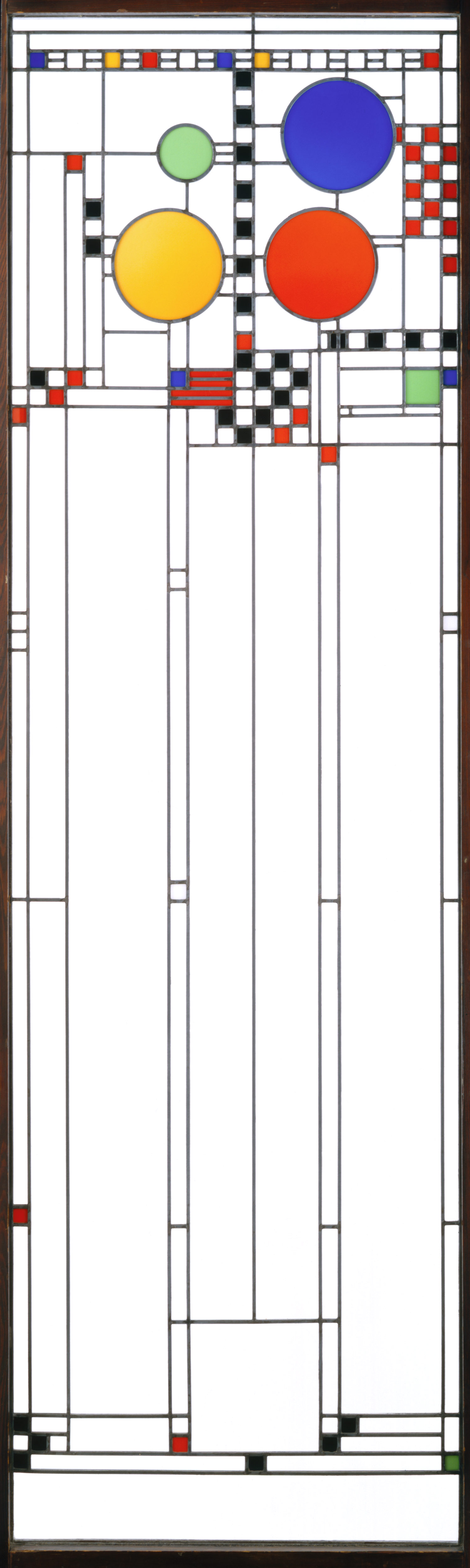
Find out more about the geometric compositions from Frank Lloyd Wright:
Michigan State UniversityVariations on a Form
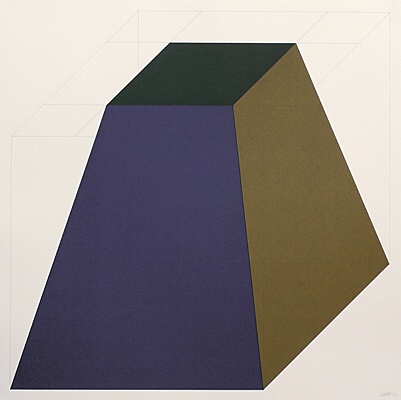 Sol Lewitt made several series of prints, some exploring variations of solids.
 This series of prints include "boundary lines," which define the limit at which the solid may grow.
Find out more about the artist Sol Lewitt: Galerie Boisseree, Tate Modern
The Durer Grid

The Durer Grid. An ancient master, print maker Albrecht Durer used a grid to accurately depict the subject of his plates.
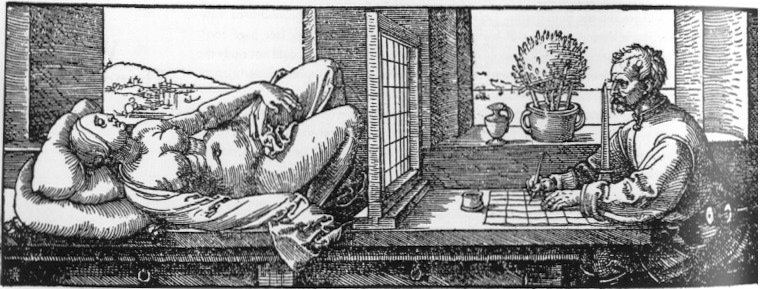 Durer partitioned the picture plane into distinct and separate areas so that he could focus on local proportions and lines.
Here's a nice video featuring a good selection of Durer's work.
Visual Sequences
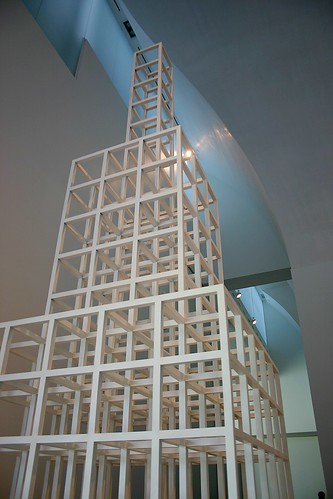 Sol Lewitt, a Minimalist artist from America.
 Lewitt didn't like to use the word "sculpture" to describe his "structures."
Find out more about the American artist Sol Lewitt: National Gallery of Art, NPR, Wikipedia
Subscribe to:
Posts (Atom)