Showing posts with label math. Show all posts
Showing posts with label math. Show all posts
Algorithms and Art

The Islands of Benoît Mandelbrot


The Bard Graduate Center recently closed a show entitled "The Islands ofBenoît Mandelbrot:Fractals, Chaos, and theMateriality of Thinking". Interesting, for a computer scientist to have a show in what has historically been an institution dedicated to showcasing the arts.
Benoit Mandelbrot is perhaps most famous for his work involving fractals (including helping to generate the mountains in Star Trek II). Fractals are shapes that exhibit the interesting property of having self-similarity. This fractal was named after Mandelbrot:

This "art" show at the Bard Graduate Center focused on the visual record of the mathematical discovery of the mysterious properties of these shapes:

It's hard to find visual artifacts to document the lifespan of a mathematical discovery. Several pieces in the show are obviously sketches of ideas that have yet to come to full fruition.
- New York Times coverage of the Islands of Benoit Mandelbrot
- Exhibition Catalog- The Islands of Benoit Mandelbrot: Fractals, Chaos, and the Materiality of Thinking
- The Computational Beauty of Nature: Computer Explorations of Fractals, Chaos, Complex Systems, and Adaptation
- Making the Genesis Effect in Star Trek II

A Hydrolic Model of the British Economy
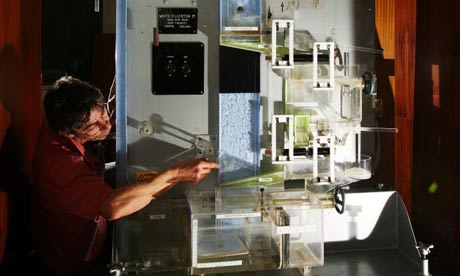 This photo from the Guardian shows Bill Phillips explaining his sculpture depicting the mechanics of the British economy. Though not a professed artist, Phillips certainly blurred boundaries between art, math, and economics.
 Aesthetic Computing is a relatively new field exploring how concepts in math and computer science might be articulated aesthetically. This caused of British economics caused quite a sensation when it debuted at the London School of Economics in 1949.
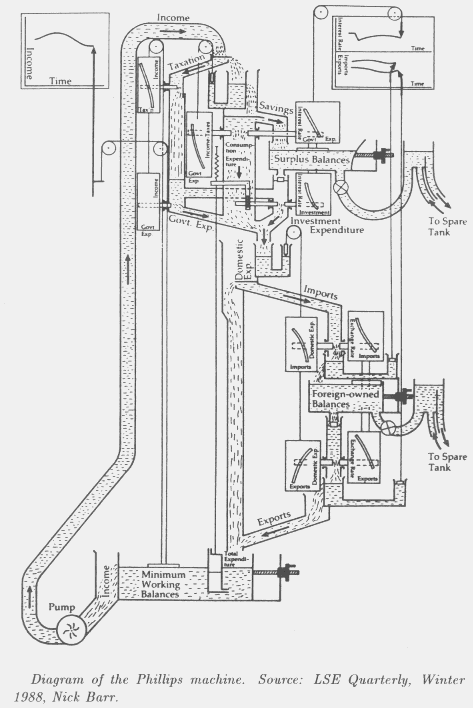 Phillips eventually became a professor at the London School of Economics and produced approximately twelve versions of his working hydrological sculpture machine, dubbed MONIAC.
Does Numerology Count as Math?
 Does numerology count as math? (No pun intended). Alfred Jensen was fascinated with numbers, the I Ching, and the Mayan calendar. But, he insists that his incorporation of mathematical ideas goes beyond the mystic.
 " My use of numbers is governed by the duality and opposition of odd and even number structures. " -Alfred Jensen in an 1997 Artist Statement.
For more information on Alfred Jenson combining math and art:
Subscribe to:
Posts (Atom)